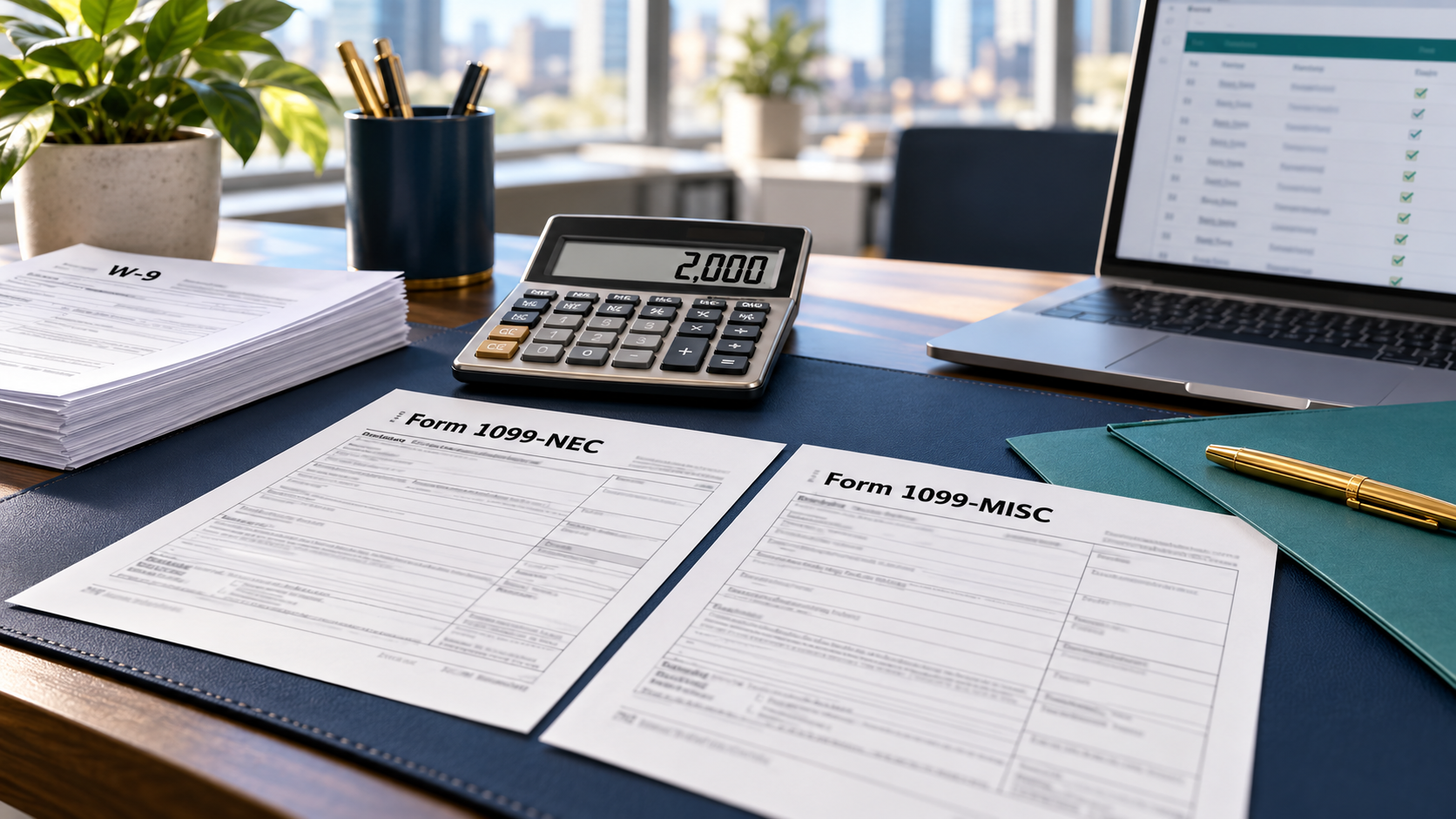
2026 Form 1099 changes raise the federal reporting threshold from $600 to $2,000 for many payments commonly reported on Forms 1099-NEC and 1099-MISC.
If your business pays independent contractors, landlords, attorneys, health care providers, or other vendors, this change could reduce the number of Forms 1099 you need to prepare after year-end.
However, the new rule is not as simple as replacing every $600 threshold with $2,000.
Different payment categories continue to follow different reporting rules. The IRS has also revised Forms 1099-NEC and 1099-MISC to accommodate information related to cash tips, Treasury Tipped Occupation Codes, and qualified overtime compensation.
Businesses should update their vendor records, accounting systems, and year-end procedures before preparing forms for payments made during 2026.
The most important updates include:
The $2,000 amount applies to qualifying payments made during calendar year 2026. Businesses will generally prepare the corresponding Forms 1099 after the year closes and file them in 2027.
For payments made after 2026, businesses should verify the applicable amount because the reporting threshold may be adjusted for inflation.
One of the most significant 2026 Form 1099 changes affects Form 1099-NEC.
Businesses generally must file Form 1099-NEC when they pay a nonemployee at least $2,000 during 2026 for services performed in the course of a trade or business.
This may include payments to:
For example, suppose a business pays an independent contractor $1,500 during 2026 for marketing services.
Under the previous $600 threshold, that payment would generally have triggered a Form 1099-NEC filing requirement. Under the new $2,000 threshold, it would generally fall below the federal reporting requirement, assuming no special rule applies.
A business that works with many smaller vendors may therefore prepare fewer Forms 1099-NEC.
Businesses should still collect a valid Form W-9 before making payments. Waiting until a vendor crosses the threshold can create problems if the vendor becomes difficult to contact or provided incomplete information.
The higher threshold also applies to several common payment categories reported on Form 1099-MISC.
Businesses generally use the $2,000 threshold for qualifying payments such as:
This change could be particularly relevant for businesses paying rent or working with multiple health care providers and other vendors.
The payment type still determines which form and threshold apply. Businesses should not categorize every vendor payment based solely on the total amount paid.
Not every Form 1099 reporting threshold increased.
Important exceptions include:
Attorney payments require particular attention.
Attorneys’ fees for legal services generally use the $2,000 threshold and are reported as nonemployee compensation on Form 1099-NEC.
Gross proceeds paid to an attorney in connection with legal services—but not for the attorney’s services, such as certain settlement payments—generally remain reportable at $600 or more on Form 1099-MISC.
This distinction is one reason businesses should classify payments before determining whether a form is required.
The vendor total shown in an accounting system may include payments made through several different methods.
Payments made by credit card, payment card, and certain third-party settlement networks generally fall under Form 1099-K reporting by the payment settlement entity. Those payments are generally not reported again by the business on Form 1099-NEC or Form 1099-MISC.
For example, a contractor may receive:
Although the contractor received $2,500 in total, the business should not automatically report the entire amount on Form 1099-NEC. The payment methods and applicable information-reporting rules must be reviewed.
Businesses should separate potentially reportable check, ACH, cash, and direct bank payments from transactions processed through payment cards or qualifying third-party networks.
This review can prevent duplicate reporting and incorrect forms.
The reporting threshold determines whether the payer must prepare an information return.
It does not determine whether the recipient’s income is taxable.
If an independent contractor earns $1,500 and does not receive Form 1099-NEC because the payment falls below the reporting threshold, that does not automatically make the income tax-free.
Recipients generally remain responsible for reporting taxable income even when they do not receive a Form 1099.
Business owners should avoid telling vendors that payments below $2,000 are “not taxable.” The new threshold changes the payer’s information-reporting obligation, not the fundamental tax treatment of the recipient’s income.
The 2026 Form 1099 changes are not limited to the reporting threshold.
The IRS revised both forms to support reporting connected to qualified tips and qualified overtime compensation.
The revised Form 1099-NEC includes:
The cash tips and qualified overtime amounts are included in the nonemployee compensation reported in box 1a but may also need to be separately identified in the new boxes.
The revised Form 1099-MISC includes:
For many businesses, these fields may not apply. However, payroll, accounting, accounts payable, and Form 1099 preparation systems should still support the revised layouts.
The business must also capture the necessary information throughout the year. Software cannot correctly populate a field if the underlying transactions were never identified or recorded appropriately.
A Form 1099 may still be required when federal income tax was withheld under the backup withholding rules, even if the payment did not reach the normal reporting threshold.
Backup withholding may apply in situations involving missing or incorrect taxpayer identification information, among other circumstances.
This is why an accurate Form W-9 collection process remains essential despite the higher threshold.
Vendor records should include:
Businesses should review backup withholding activity separately rather than relying only on a report of vendors paid $2,000 or more.
The higher threshold should reduce unnecessary reporting, but it can also create errors if a business simply reuses its previous procedures.
An updated year-end process should answer these questions:
The IRS instructions for Forms 1099-MISC and 1099-NEC should be consulted when determining the proper treatment of a specific payment.
Review vendor names, addresses, taxpayer identification numbers, federal tax classifications, and Forms W-9.
Contact vendors now when information is missing or inconsistent. January is not the ideal time to begin chasing documentation.
Identify vendors approaching or exceeding $2,000. Separate payments by type and payment method instead of looking only at the total paid.
Determine whether a payment represents an attorney’s fee for services or gross proceeds paid in connection with legal services. These categories may have different thresholds and forms.
Verify that the accounting, payroll, accounts payable, or tax software supports the December 2026 revisions of Forms 1099-NEC and 1099-MISC.
The system should accommodate the new fields for cash tips, Treasury Tipped Occupation Codes, and qualified overtime compensation when applicable.
Do not wait until forms are due to identify unusual vendor arrangements, backup withholding, settlement payments, or unclear classifications.
A qualified tax professional can help determine which form and reporting rule apply to a specific transaction.
The federal reporting threshold is generally $2,000 for qualifying nonemployee compensation payments made during 2026.
No. Several categories use the $2,000 threshold, but royalties, gross proceeds paid to attorneys, direct sales, backup withholding, and certain other payments follow separate rules.
Generally, payments made through credit cards and qualifying third-party settlement networks are reported by the payment settlement entity on Form 1099-K rather than by the business on Form 1099-NEC or Form 1099-MISC.
No. A reporting threshold determines whether the payer must issue a form. It does not automatically determine whether the income is taxable to the recipient.
Forms reporting calendar-year 2026 payments are generally prepared and filed in early 2027. Businesses should confirm the applicable filing and recipient-statement deadlines before submitting them.
2026 Form 1099 changes should reduce the number of information returns many businesses need to prepare. However, the new rules make accurate payment classification even more important.
The correct question is no longer simply:
“Did we pay this vendor more than $600?”
The business must determine:
“What did we pay, how did we pay it, how much did we pay, and which reporting rule applies?”
That process can prevent unnecessary filings, duplicate reporting, and missed forms.
NeatBooks helps businesses maintain accurate accounting records and prepare for year-end tax compliance throughout the year.
Our team can help organize vendor records, reconcile payments, review vendor activity, identify potential Form 1099 reporting issues, and make sure your accounting information is ready before tax season begins.
You can also review our tax planning and preparation services and Form 1099 resources for additional support.
The best time to identify a Form 1099 problem is not at the end of January. It is before the year closes.
If your business works with contractors, vendors, attorneys, or multiple entities, talk to NeatBooks about reviewing your 2026 vendor reporting process.
This article provides general educational information and is not a substitute for advice regarding a specific tax situation.




Privacy Policy | Terms and Conditions | Powered by Purity
At NeatBooks, we know you want to focus on growing your business without the stress of messy books, missed deadlines, or worrying if you’re leaving money on the table. The problem is, financial complexity and unreliable support from previous accountants can leave you feeling stuck, overwhelmed, and vulnerable to costly mistakes.
It doesn’t have to be this way! Every entrepreneur deserves a financial partner who simplifies the chaos, provides proactive guidance, and empowers them to make confident decisions.
With over 300 businesses transformed and a team that speaks your language (no jargon, just straight talk), NeatBooks combines expert financial strategies with a personal touch. We’re here to turn complexity into clarity and help you ProsperNeatly™.
Here’s how we do it:
Step 1: Schedule a Discovery Call - Let’s understand if we are a good fit, first. Then, we’ll move
into an assessment of where you are and what actions we need to take together to help you gain
clarity and financial organization.
Step 2: Strategize & Optimize - Together, we build a plan customized for your business and
your goals, and we execute.
Step 3: ProsperNeatly™ - You gain the confidence that comes with having a reliable, competent
partner managing the financial side of your business.
Let’s get started by scheduling a Discovery Call today. In 15 minutes, you’ll know how we can impact your business.
In the meantime, we invite you to download any of our free resources that have been built to support entrepreneurs in the food service, construction, and real estate development and investment spaces