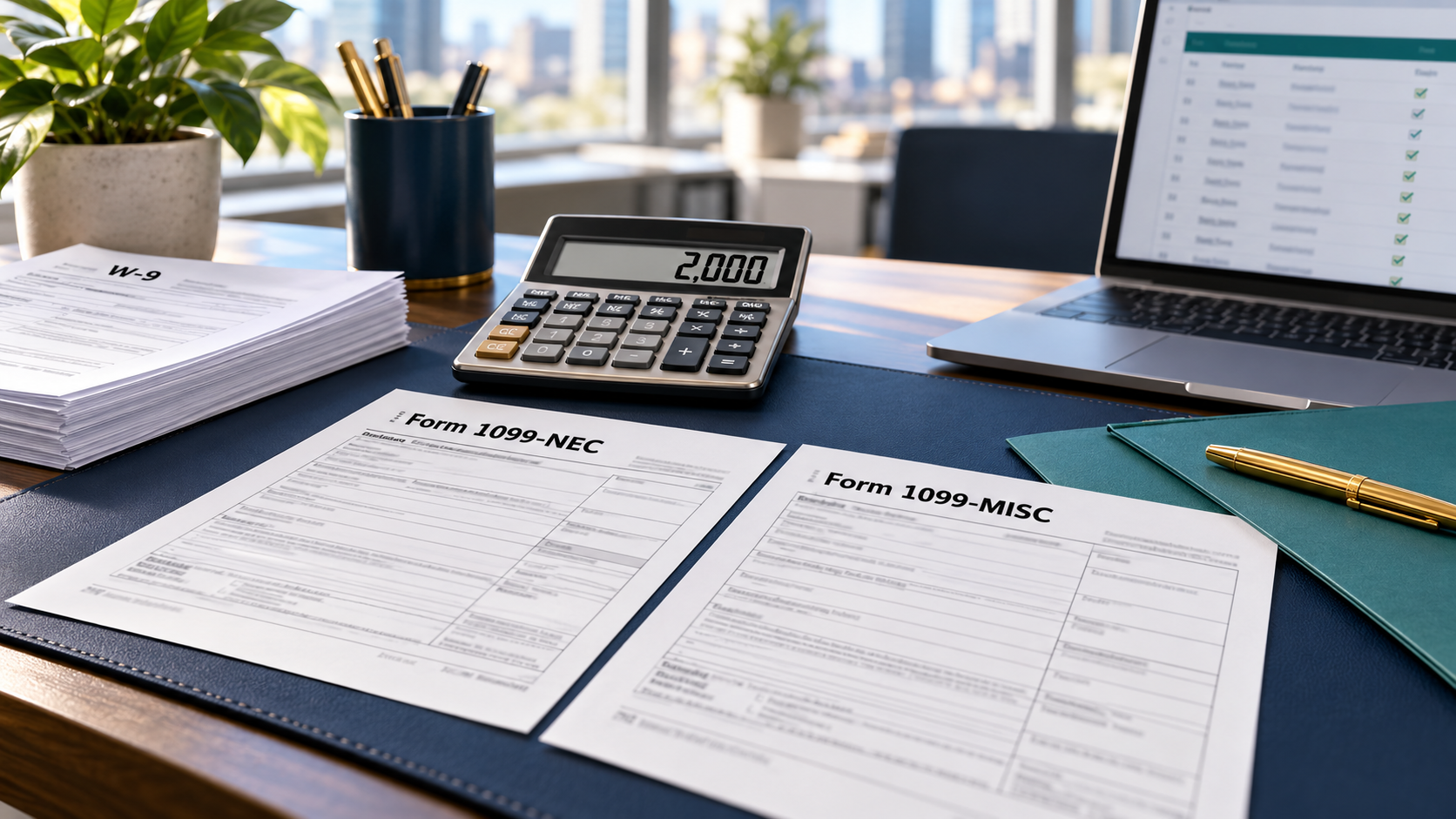
2026 1099 threshold changes require a closer look at your vendor reporting process.
If your business pays independent contractors, landlords, attorneys or other service providers, a familiar year-end tax rule is changing for 2026. For many common payments reported on Forms 1099-NEC and 1099-MISC, the federal reporting threshold goes from $600 to $2,000.
That sounds simple, but it isn’t quite. The higher threshold should mean fewer 1099s for many businesses, but it doesn’t apply to every type of payment. At the same time, the IRS redesigned parts of Forms 1099-NEC and 1099-MISC to capture new information on cash tips, tipped occupations and qualified overtime compensation. Year-end 1099 preparation should look different this year.
Beginning with payments made in 2026, the IRS increased the reporting threshold for several types of payments from $600 to $2,000. One of the most important changes affects Form 1099-NEC. Businesses generally must file Form 1099-NEC when they pay a nonemployee at least $2,000 during 2026 for services performed in the course of a trade or business. That can include independent contractors, consultants, accountants, architects, engineers, certain attorneys and other nonemployee service providers.
For example, if your company paid an independent contractor $1,500 during 2026, that payment would generally fall below the new 1099-NEC threshold. Under the old $600 rule, the same payment would generally have triggered a filing requirement. For companies that work with a lot of smaller vendors, that could significantly reduce the number of 1099s at year-end.
Review the vendor’s total reportable payments for the year, not just individual invoices. Several smaller payments can add up to the 2026 1099 threshold even when no single invoice reaches $2,000.
Several common categories reported on Form 1099-MISC also move to $2,000, including many payments for:
This is where you need to be careful: not every Form 1099-MISC threshold changed to $2,000. The IRS instructions still provide different thresholds for certain categories, including:
So don’t just change every $600 threshold in your year-end procedures to $2,000. The payment type still matters.
For the 2026 1099 threshold review, separate legal service fees from gross proceeds paid to attorneys. Those are different reporting categories, even when the payee is the same law firm. Ask your tax adviser which category applies before updating the vendor’s reporting settings.
Business owners and contractors sometimes mix this up. A reporting threshold determines whether the payer must issue an information return. It does not determine whether the income is taxable to the recipient. If an independent contractor earns $1,500 and doesn’t receive a Form 1099-NEC because the payment is below the threshold, that $1,500 isn’t automatically tax-free. Taxable income generally remains reportable by the recipient even when no Form 1099 is issued.
Keep that distinction clear when discussing the 2026 1099 threshold with vendors. Fewer forms do not remove the need for accurate income and expense records. Explain that the 2026 1099 threshold concerns the payer’s reporting obligation.
The threshold isn’t the only change for 2026. The IRS added new fields for reporting connected to the new federal deductions for qualified tips and qualified overtime.
The 2026 Form 1099-NEC includes fields for cash tips (businesses may need to separately identify qualifying cash tips included in nonemployee compensation), the Treasury Tipped Occupation Code (the occupation in which the recipient earned the tips) and qualified overtime compensation (qualifying overtime included in the reported income). Form 1099-MISC received corresponding fields for cash tips, Treasury Tipped Occupation Codes and qualified overtime compensation.
Many businesses may never use these fields. But payroll, accounting, AP and 1099 preparation systems still need to be updated so the right information can be captured when the rules do apply.
Review the form changes alongside the 2026 1099 threshold. Updating the dollar limit alone does not confirm that your software supports every applicable field on the revised forms. Ask your preparer to document any 2026 1099 threshold exceptions that affect your vendor list.
The move to $2,000 should cut unnecessary reporting. It also opens the door to errors if you simply reuse last year’s procedures. Your year-end 1099 process should now answer these questions:
That last one matters because a Form 1099 may still be required when federal income tax was withheld under the backup withholding rules, regardless of whether the payment reached the normal reporting threshold.
Assign someone to follow up on questions found during the 2026 1099 threshold review. Record what needs clarification, who will resolve it and when the answer is due. Use that record to keep 2026 1099 threshold decisions consistent when another team member reviews the file.
Review your vendor files before year-end instead of waiting until January. I’d start with four steps:
For businesses with several entities, organize the 2026 1099 threshold review by paying entity. During the 2026 1099 threshold review, keep each company’s vendor records and payment reports identifiable rather than relying on one combined list without knowing which business made the payments.
The new threshold should make year-end reporting easier for many businesses, but it makes classification more important. The question used to be “Did we pay this vendor more than $600?” The better question now is “What did we pay this vendor, how much did we pay, and which reporting rule applies?” Asking it that way prevents unnecessary filings and helps you avoid missing forms that are still required.
Use the 2026 1099 threshold as a reason to check your process, not simply change a number in your software.
NeatBooks helps businesses keep accurate accounting records and stay ready for year-end tax compliance throughout the year. That includes reviewing vendor activity, reconciling payments, identifying potential 1099 reporting issues and making sure the books are ready before tax season begins.
Our tax planning and preparation services connect that review with your broader compliance needs. If the 2026 1099 threshold raises questions about a payment or vendor classification, we can help evaluate the next steps using your accounting records.
The best time to clean up a 1099 problem is not January 30. It’s before the year closes. If your business works with contractors, vendors or multiple entities, now is the time to review your 2026 vendor reporting process.
Need help getting your books and vendor records ready for year-end? Talk to NeatBooks about your 2026 accounting and tax compliance.

Privacy Policy | Terms and Conditions | Powered by Purity
At NeatBooks, we know you want to focus on growing your business without the stress of messy books, missed deadlines, or worrying if you’re leaving money on the table. The problem is, financial complexity and unreliable support from previous accountants can leave you feeling stuck, overwhelmed, and vulnerable to costly mistakes.
It doesn’t have to be this way! Every entrepreneur deserves a financial partner who simplifies the chaos, provides proactive guidance, and empowers them to make confident decisions.
With over 300 businesses transformed and a team that speaks your language (no jargon, just straight talk), NeatBooks combines expert financial strategies with a personal touch. We’re here to turn complexity into clarity and help you ProsperNeatly™.
Here’s how we do it:
Step 1: Schedule a Discovery Call - Let’s understand if we are a good fit, first. Then, we’ll move
into an assessment of where you are and what actions we need to take together to help you gain
clarity and financial organization.
Step 2: Strategize & Optimize - Together, we build a plan customized for your business and
your goals, and we execute.
Step 3: ProsperNeatly™ - You gain the confidence that comes with having a reliable, competent
partner managing the financial side of your business.
Let’s get started by scheduling a Discovery Call today. In 15 minutes, you’ll know how we can impact your business.
In the meantime, we invite you to download any of our free resources that have been built to support entrepreneurs in the food service, construction, and real estate development and investment spaces